How to Clean a Wood Deck Without Ruining It: Pressure, Bleach, and the One Test That Comes First
Most deck-cleaning advice is written for pressure-treated pine. Your deck might be cedar, redwood, composite, or a coated finish -- and the pressure and chemistry that are safe on one will damage another. Start with what the boards actually are, then clean with the grain and the right chemistry, not the highest pressure the machine will do.
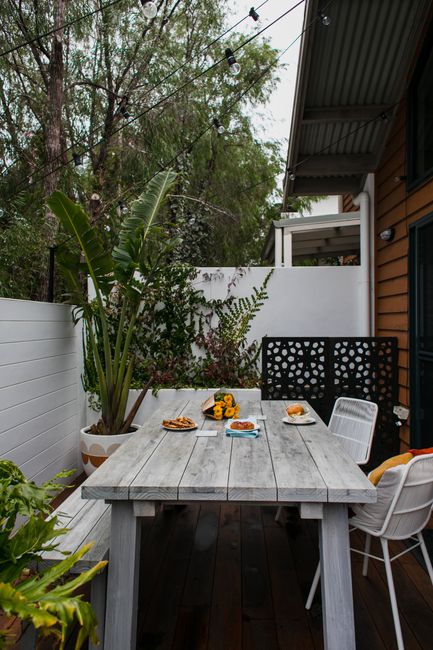
First identify what the deck is made of -- pressure-treated pine, cedar or redwood, composite, or a sealed/coated finish -- because the safe pressure and chemistry change with the material. For a standard treated-wood deck, the safe method is oxygen-based cleaner (sodium percarbonate) or hydrogen peroxide, never chlorine bleach, which breaks down the lignin in the wood and leaves it fuzzy and gray; a fan-tip wand kept back 16-24 inches with the lowest pressure that cleans, worked along the grain; and a deck brightener (oxalic or citric acid) after, to bring the wood back to neutral before sealing. On a Gulf Coast deck, the timing matters more than the technique: clean after the pollen drop and before the rainy season, because pollen and shade hold the food source mildew needs.
A deck is not a driveway and it is not a fence. It is a walking surface that lives outside, holds water in its grain, and takes a beating from feet, furniture, pollen, and every storm that blows through. The advice that treats all three the same is the reason decks get fuzzy, bleached, or splintered -- the wrong cleaner or pressure on the wrong material, done repeatedly, leaves permanent damage long before the dirt does.
The single thing that decides how you clean a deck is what it is made of. So the first step is not buying a cleaner or renting a machine -- it is getting the material right, because the safe pressure and the safe chemistry change with it.
Step one -- find out what the deck is before you touch it
There are four common deck materials on the Gulf Coast, and they do not clean the same way. Get the material wrong and you clean with rules that damage the surface you are trying to fix.
Pressure-treated pine. The most common deck in the last twenty years of building -- the greenish, chemically preserved boards most newer decks are built from. Soft, porous, and what kills it is not dirt but bleach and too much pressure.
Cedar or redwood. The older or higher-end decks, softer than treated pine with a more open grain, and even more intolerant of chlorine and high pressure -- the colour and grain are the point and both bleach and a hard blast take them out.
Composite. Capped or uncapped wood-and-polymer boards -- Trex, TimberTech, and the rest. Structurally different from wood; no cellulose, no grain to raise. Covered in full on the composite decking guide -- if you are not sure whether yours is wood or composite, read that page first. Short version: capped composite can take a carefully held pressure washer; uncapped cannot; bleach lightens the cap on both.
Sealed, stained, or painted wood. Any wood deck that has been coated. Here you are cleaning the finish, not the wood, and the finish decides the method -- a film-forming sealant clouds or peels under the wrong product, and a stain you strip with the wrong chemistry is a refinishing job you did not mean to start.
The tells. Untreated or lightly treated pine goes gray quickly in the sun and usually reads as a plain open-grain pine. Cedar and redwood have a recognizably different grain and colour and were common in higher-end builds. Composite boards are uniform, often with a repeat pattern in the grain, and rarely show knot holes. A sealed deck beads water when fresh and glossy; once that gloss begins to fail the water soaks in and the finish is on its last legs.
If you cannot tell, the safe assumption is the gentlest rules -- soap and water, a soft brush, a garden hose -- and a pro who can tell you what you have before doing anything else. The Sarasota-area deck and patio crew we point readers to works composites and wood differently for exactly that reason.
Why chlorine bleach is the wrong tool on almost every wood deck
The instinct to reach for household bleach on a gray or green deck is near-universal, and on a wood deck it is the one that does the most lasting damage. The treated-wood manufacturer Viance is direct about why: chlorine bleach -- sodium hypochlorite -- breaks down the lignin in wood, causing excessive damage to wood cells, and because the natural pH of wood is slightly acidic, bleach shifts it to a basic pH that damages the cellular structure. The visible results are what people actually live with: an unnatural whitewashed appearance, raised wood fibres that look fuzzy, and corrosion of the metal fasteners, screws, and nails holding the deck together. Bleach also does not eliminate the spores from which mould and mildew grow, which is why a bleach-cleaned deck is back in the same shape the next season -- the growth was only suppressed, not removed at the source.
Two more things the manufacturer lists: bleach can cause damage to surrounding plants, and after several months it lightens the wood's natural colour -- permanently, on a deck where the colour is the point. None of that is what you were after.
The alternative the manufacturer and many pros actually use is oxygen-based. Sodium percarbonate -- a white powder, non-toxic, biodegradable, leaving no harmful residue -- is a cleaning and bleaching agent with a strong fungicide effect, and has been found more effective at attacking deeper-rooted organic growth on porous wood surfaces than surface-stripping chlorine. Hydrogen peroxide works the same way: it releases an oxygen molecule into the growth and leaves water behind, killing what is there without leaving the wood chemically damaged.
The third step in a proper wood deck clean is a brightener. Because most deck cleaners -- even the oxygen-based ones -- raise the pH of the wood, a deck brightener based on oxalic or citric acid is used afterward to neutralise the cleaner and bring the wood back to its natural pH, which is what lets a fresh stain take evenly and look right. Skip the brightener and a stained deck can come out blotchy -- the cleaner left the wood alkaline, and the stain did not take the same on every board.
The pressure rules -- and the one test that comes first
If a pressure washer is used at all on a wood deck, the rule from the manufacturer and every careful source is the same: the lowest pressure that actually cleans, and the widest fan tip you own. Viance's guidance is specific: use the lowest possible pressure that effectively cleans the surface, with a fan-tip only, set for an angle of spread between 40 and 60 degrees, and never a narrow stream or a rotating "tornado" type of tip.
The distances matter because wood gets damaged before concrete does. Start at least 24 inches away from the deck, pointed away from people and glass, and once the fan spread is set, slowly feather the spray in to about 18 inches. Test in an inconspicuous area first -- a corner or the underside of a board near the house -- and not the main surface you can see from the yard. In general, avoid spraying closer than 16-20 inches unless the pressure is very low.
The motion is the other half. Walk slowly, hold the sprayer steady at a level distance and angle, and work with the grain, feathering the spray lengthwise along the boards and overlapping each pass slightly. The objective is even cleaning with no visible differences from board to board -- not a hard blast. The instinct to pivot at the wrist is what leaves a streak across a board, and a streaked board is a board you just damaged.
Start at the boards closest to the house and work outward, so the runoff from each section does not land on the clean surface behind it. On a Gulf Coast deck that slope usually runs away from the house anyway, but you still want the clean water and the dirty runoff going in the same direction.
The real Gulf Coast timing -- and why pollen is the clock
On this coast the deck job is not a once-a-year or once-a-season thing in the way a northern guide implies. The climate keeps the deck damp for most of the year, and the pollen drop that runs through spring and early summer drops exactly the food source mildew and algae feed on.
Viance's mould guidance names the four things mould and mildew need to grow -- air, water, temperatures between 32 and 120 degrees, and a food source of dead or decaying organic matter -- and on a Gulf Coast deck all four are usually present for most of the year. The control is water and food. That means adequate ventilation under and between the deck boards so water can evaporate, gaps that stay clear of debris so rain can rinse the underside, and keeping the deck clear of leaves and the wet mulch that stays against the structure.
The practical timing. Clean the deck just after the last of the major pollen events -- when the car stops changing colour from pollen, the same cue the manufacturer uses -- because that is when the seasonal outbreak of mould and mildew is about to start, and a deck cleaned before the season is one that does not need rescuing during it. A periodic rinse with a garden hose, especially after the major pollen events, is enough to keep the surface from sitting dirty between proper cleans.
One more Gulf Coast detail that is easy to miss. Gutters, downspouts, and dryer vents that discharge directly onto the deck keep one patch wet all the time, which is how a small dark band becomes a fixed mould problem. The fix is usually redirecting the discharge off the deck, not stronger cleaner on the deck.
What not to do -- the mistakes that make a deck look worse later
Do not use chlorine bleach on a wood deck unless a pro has told you the finish and the wood will take it. On treated pine it raises the grain and whitewashes the colour and corrodes the fasteners; on cedar and redwood it takes out the colour that is the reason you have those species in the first place; on any coated deck it is cleaning the finish and may take it off in patches. The cleaner the internet says to use is rarely the right one for a wood deck.
Do not use a narrow or rotating tip. That is the difference between cleaning a deck and cutting it. A 0-degree or turbo tip on wood is how a deck gets strip marks in one pass -- and those marks are permanent on the surface.
Do not hold the wand still or work perpendicular to the boards. Keep the spray moving along the grain, at an angle to the grain if the surface is bad, never stopped on one spot. A stationary jet on wood is how you get a gouge.
Do not clean a wet deck. If it just rained or the irrigation hit it, the wood is holding water and the cleaner cannot do its job -- it sits on top, dries unevenly, and leaves the residue that makes a deck look worse after you cleaned it. Start on a dry deck.
Do not skip the brightener on a stained deck. Soap and rinse a wood deck and you have a clean grey surface; clean it with a deck cleaner and you have a wood surface that is now alkaline, and stain it without neutralising and the colour comes out blotchy. The brightener is not optional on a stained deck.
Do not use a salt-based ice melt on the deck in winter, and do not use sand for traction -- salt corrodes the fasteners and leaves the surface damp, and sand is abrasive enough to scratch the wood. The manufacturer's guidance on winter care is to shovel parallel to the boards and avoid anything that scores the surface.
When it is worth handing it over
A standard treated-wood deck in ordinary condition -- grey film, pollen, the usual organic growth -- is a job a careful homeowner can do with a garden hose, an oxygen-based deck cleaner, a stiff synthetic brush, and patience, working in sections and rinsing thoroughly. That is the manufacturer's baseline, and it is most of the value on the page.
What is worth paying for is narrower. A deck that has been cleaned with bleach before and now has raised grain or a whitewashed look -- that is damage already done, and it wants a pro who can assess whether it can be brightened and refinished or whether the wood is too far gone. A stained or sealed deck that needs refinishing -- the cleaner, brightener, and stain sequence is a multi-step job and the sequence is easy to get wrong the first time. A deck with the wrong coating or a failing finish -- diagnosing what is on it before you clean it is the whole job, and a pro who does this regularly already knows the difference. A deck where the fasteners are corroding from past bleach use -- that is a structural call, not a cleaning call, and it is the kind of thing you notice only when you are already looking closely.
Around Sarasota, Bradenton, Venice and Lakewood Ranch, the crew we point deck owners to works wood decks at low pressure as a rule and can tell you what the deck is made of before it starts. Whoever you use, the question that sorts them in one answer is the one this whole page is built on: "What is the deck made of, and what pressure and chemistry do you use on that material?" A crew that answers with the material, the pressure, and the cleaner has done this before. A crew that says "we blast decks" has told you everything you need to keep looking.
Frequencies and costs -- what the deck actually needs
The honest schedule for a Gulf Coast wood deck is not "once a year" in the abstract. It is tied to what lands on it.
A deck in full sun, used regularly, and kept clear of leaves and wet mulch can go two or three years between proper cleans -- the sun and the drying do more than people think. A shaded deck, a deck under trees, one where the gutters dump onto it, a deck in the lee of the house -- these want attention more often, because the water and the food source never leave on their own and the mould keeps growing between cleans. The rule from the manufacturer is to clean just after the major pollen events, and for most of the Gulf Coast that means spring and the start of the rainy season.
Sealing is the other half of keeping a wood deck from going grey and from checking and splintering. Viance's guidance is to apply a water-repellent sealer at least every two years, and to stain or seal when the wood is dry -- tested by dropping water on it and seeing whether it absorbs. A deck that will not take water is too wet to stain; a deck that soaks it right in is ready. The sealer is what slows the sun greying, and the greying is what makes a deck look old before it is old.
Ranges crews quote for a Gulf Coast wood deck: a standard single-level treated-wood deck, pressure-washed and rinsed, usually lands in the hundreds, with the number moving on size, access, slope, and how much of the surface is shaded or has sat under trees. A refinishing -- clean, brighten, stain or seal -- is a different job and a different price, and it is one where the sequence and the drying time matter more than the square footage.
There is no honest way to put a single number on it without knowing the deck. The useful frame is narrower: a simple wash is a homeowner job for most people, and a refinishing or a deck with damage already done is the part to get a pro on.
Frequently asked
How do I clean a wood deck without damaging it?
Is bleach safe to use on a wood deck?
What PSI should I use to clean a wood deck?
How often should a wood deck be cleaned in Florida?
Do I need to brighten my deck after cleaning it?
What is the difference between cleaning wood and composite decking?
More How-To
 How-To
How to Clean Outdoor Furniture on the Gulf Coast: A Q&A for Sling, Cushions and Powder-Coated Aluminium in Salt Air
Most outdoor-furniture cleaning advice is written for a climate where the furniture gets rained on and then dries out. O…
Read How-To
How to Clean Composite Decking on the Gulf Coast: Which Generation You Own Decides the Rules
Most composite-decking cleaning advice is written as if every board on the market were the same material. It is not. Whe…
Read