How to Clean Composite Decking on the Gulf Coast: Which Generation You Own Decides the Rules
Most composite-decking cleaning advice is written as if every board on the market were the same material. It is not. Whether your deck may even see a pressure washer depends entirely on which generation you bought — a capped board from the last decade and a first-generation board from twenty years ago are governed by different, sometimes opposite, rules, and the number one way people damage a composite deck on this coast is to apply the pressure-washer rules of one generation to the other. Everything below starts by identifying yours.
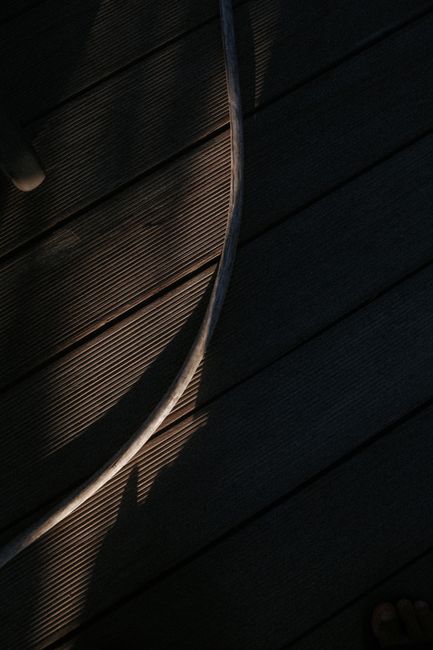
Capped composite from the last decade — boards with a protective shell, like Trex’s Transcend, Enhance and Select lines — can be cleaned with warm soapy water and a soft bristle brush, and may see a pressure washer of no more than 3100 psi with a fan tip held at least 8 inches (203 mm) off the surface, per the manufacturer. Uncapped or early-generation boards are a different story: Trex states that pressure washing early-generation decking “could damage the decking surface and will void the warranty,” so those get soap, a brush and a garden hose only. The one rule that applies to every composite deck on the market is the one that hurts the most to learn: bleach will lighten the cap. The stain in the grain is organic growth feeding on trapped debris — remove the food source with soap and scrubbing, don’t try to bleach it away.
Composite decking is sold on the promise that it never needs the maintenance a wood deck does, and that is roughly true — but the maintenance it does need is specific, and it is specific in ways the marketing rarely explains. The surface you bought is not a slab of inert plastic. It is a wood-and-polymer composite, and on the newer boards it is wrapped in a protective polymer cap, and each of those layers behaves differently under a spray wand. Most of the damage done to composite decks on this coast is done by somebody who assumed all of it was the same thing.
Here is the single fact that sorts the whole page. There are effectively two generations of composite decking on the market, and the rules for cleaning them do not just differ — on the one question that matters most, the pressure washer, they are opposite. A capped board from the last decade can take a gentle pressure wash. An uncapped or early-generation board can be permanently damaged by one, and the manufacturer says so in terms that void your warranty. Get that one distinction right and almost everything else follows.
The cap is the thing you are protecting
Modern composite decking is capped: a hard polymer shell moulded over a composite core, giving the board the wood grain, the stain resistance and the colour that newer decks show. That cap is what a pressure washer endangers and what bleach attacks. Older composite — the first-generation boards, and still many budget lines today — has no separate cap; the composite itself is the surface, and it is far more fragile under pressure.
The distinction is not cosmetic, it is the difference between a clean deck and a ruined one. A pressure washer aimed at an uncapped board can scour the surface, and the manufacturer is explicit that the damage is on you: Trex’s care guide states that pressure washing early-generation decking “could damage the decking surface and will void the warranty with respect to any condition caused by the pressure washing.” Note what that sentence is doing. It is not a cautionary note; it is a statement that if you blast an uncapped board, the resulting damage is not covered. The cap on a modern board is precisely the thing that lets you use a wand at all — and even then, within a strict limit.
The pressure numbers, by generation
The numbers the manufacturers actually publish differ sharply, and most online advice repeats only the modern figure. Here is the honest split, from the manufacturers’ own care documentation.
| Modern capped decking (e.g. Trex Transcend / Enhance / Select) | Soap + soft bristle brush; pressure washer up to 3100 psi, fan tip, at least 8 in. (203 mm) off the board |
| Early-generation / uncapped composite | Soap + soft bristle brush and a garden hose only; Trex says pressure washing “could damage the decking surface and will void the warranty” |
Trex, the largest name in the category, puts the capped-board limit in writing in its care and cleaning guide: a pressure washer “with no greater than 3100 psi” fitted with a fan attachment and a soap dispenser, spraying each board and then “rinse(ing) each individual deck board using a fan tip no closer than 8 in. (203 mm) from the decking surface.” The margin matters. A rental unit at the corner store typically delivers 2,700–3,300 psi at the tip — meaning a brand-new capped deck is right at the edge of what the machine will put out, and you have to hold the wand eight inches back just to stay inside the limit. TimberTech’s guidance is stricter still, allowing a power washer “for rinsing only” at “a maximum PSI of 1,500 and a fan tip nozzle,” and adds that the washer should not even be sitting on the deck surface while it runs.
So the honest answer to the question everybody brings here — can I pressure wash my composite deck? — is: it depends on which generation you own, and on no more than 3100 psi held eight inches off the board if you do. If you cannot identify your deck’s generation, the safe move is the one that works on both: warm soapy water, a soft bristle brush, and a garden hose.
Mildew in the grain, not on it
On a Gulf Coast deck, the thing you are actually fighting is almost never dirt. It is mildew and algae living in the texture of the board — in the embossed grain that the cap is moulded to look like wood. That grain holds moisture and debris in microscopic valleys, and on a shaded or north-facing deck the humidity on this coast keeps those valleys damp for most of the year. The result is the black-green film that reads as “my deck is dirty” but is actually organic growth with a food source.
The fix follows from the cause. Both Trex and TimberTech describe the same sequence for mildew: remove the debris, apply warm soapy water, scrub with a soft bristle brush, and rinse thoroughly — and, critically, rinse thoroughly. Trex notes that debris left on the surface feeds the growth, and recommends “a hose and warm, soapy water with a soft bristle brush” to remove “the food source and mold.” The words food source are the whole insight: if you kill the mildew but leave the pollen, leaf dust and salt film it was eating, it will be back within the season. The grain is where the growth lives and where you have to scrub — along the grain, with the brush working into the texture, not a single cursory pass.
The no-bleach rule, stated plainly
Here is the rule that most people on this coast learn the expensive way. Do not reach for bleach. It is the instinct from every wood-deck or concrete-cleaning page on the internet, and it is exactly wrong for composite — because bleach attacks the very cap you are trying to protect. Trex is blunt: “Use of products containing bleach or acid will lighten the surface of Trex.” The word to sit on is lighten. It is not a clean; it is a permanent change in colour, on a board that is supposed to keep its colour for decades, and it is not something you can scrub off or fix. The lightening happens exactly where the bleach sat the longest — so a bad bleach job reads as blotchy, patchy colour loss that no later cleaning ever undoes.
If a grey-green stain will not lift with soap and brushing, the manufacturers’ documented alternative is a composite deck cleaner made for the material — not household bleach. TimberTech’s five-step guide is built around a cleaner specifically formulated for composite, applied in sections so it does not dry (a cleaner left to dry “may leave a white film”), and rinsed before it does. That, and not bleach, is the honest answer to the mildew question.
What the Gulf Coast changes
Every interval on this coast is shorter than the one the national guides assume, and a composite deck is no exception. Humidity keeps a shaded deck damp for most of the year, airborne salt settles in the grain and holds moisture against it, and the pollen drop — the pine and oak sequence that is the subject of our Panhandle pollen guide — delivers exactly the food source mildew feeds on. The practical translation is that on this coast you clean a composite deck on a schedule, not when it looks bad: a light soap-and-water pass after the pollen drop, and again after the rainy season, keeps the grain from ever becoming a long-term food source.
Two Gulf Coast specifics are worth stating outright. First, rinse thoroughly — more than you think is necessary. Hard, mineral-rich water left to dry on a composite board leaves a film (Trex suggests vinegar for hard-water spotting, then a rinse, because the treatment water itself should not be hard), and on a coast where the tap water is hard in many metros, a deck that was cleaned but not rinsed looks worse than it did before. Second, a capped deck on the water’s edge is still at the mercy of salt; it does not rot like wood, but the cap is what protects the colour, and preserving the cap — no bleach, no abrasive, no pressure past the limit — is the entire job on a coastal deck. For how the deck sits alongside the roof, the walls and the driveway on one calendar, the coastal cleaning-interval guide puts every surface on the same schedule.
What it costs to hand it over
Composite decking is one of the jobs where, more than on most surfaces, the professional value is knowing the generation and not exceeding the number. A crew that blasts an uncapped board at 3,000 psi is not saving you money — it is writing the warranty off the board. Around Pensacola and Gulf Breeze, where the decks are newer and the salt load is high, the deck-cleaning crew we point composite-deck owners to works composites at low pressure and can tell you which generation you own before they start.
Whatever you do it yourself or hand it over, the question that sorts a good crew from a bad one is the same question this whole page is built on: “What pressure do you run on composite decking, and do you know whether mine is capped?” A crew that answers with a number at or under the limit and asks to see the deck before quoting has done this before. A crew that says “no problem, we blast decks all day” has told you everything you need to keep looking.
Frequently asked
Can you pressure wash composite decking?
Is bleach safe on composite decking?
How do I get black mildew off a composite deck?
Why does my composite deck have white spots?
How often should I clean a composite deck in Florida?
More How-To
 How-To
How to Clean Roof Shingles on the Gulf Coast: A Checklist Before You Touch the Roof
Almost every roof-cleaning page starts with the stain. On a shingle roof the more useful question is whether the surface…
Read How-To
How to Clean Outdoor Furniture on the Gulf Coast: A Q&A for Sling, Cushions and Powder-Coated Aluminium in Salt Air
Most outdoor-furniture cleaning advice is written for a climate where the furniture gets rained on and then dries out. O…
Read