How to Clean a Concrete Patio on the Gulf Coast: Almost Everything Staining It Came From You, Not the Weather
A driveway is stained by the sky and the street. A Gulf Coast patio is usually roofed, screened, and standing next to a pool — so it is stained by sunscreen, body oil, splash-out and whatever the pool cabinet leaks. Two facts change the whole job before you buy a single bottle: nothing up there ever gets rinsed by rain, and the floor is very often not concrete at all.
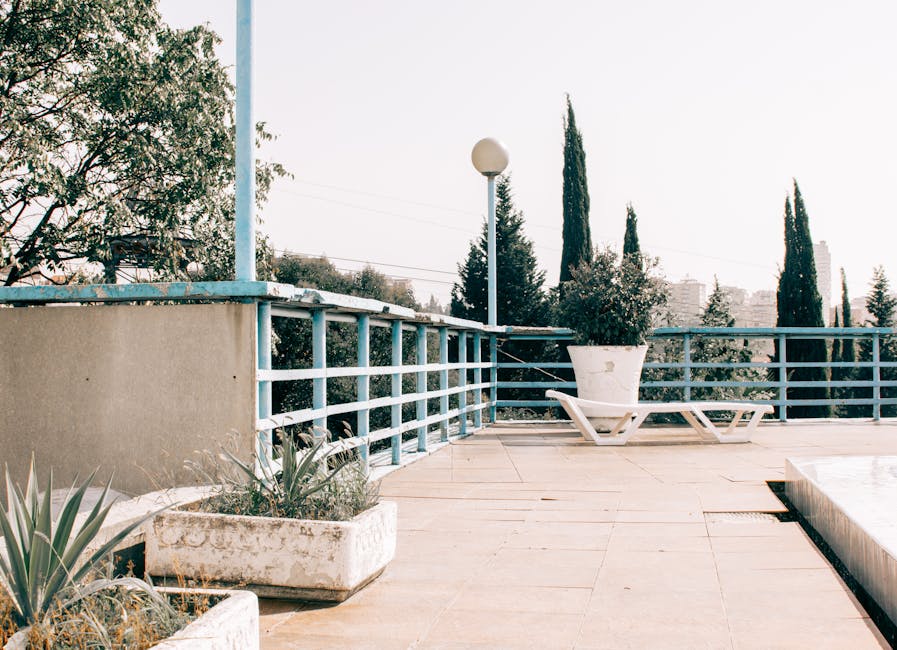
Start by finding out what the floor actually is. If it is a textured cementitious overlay — Kool Deck and its relatives, the speckled cool-to-the-touch finish on a huge share of Florida pool decks — the manufacturer’s own routine is “strong soap and water and a nylon bristle broom to scrub the surface and then rinsed clean with a garden hose,” and it states plainly that “the deck owner should not attempt Muriatic acid washes.” On a covered or screened patio, dwell time is easy and the rinse is the hard part, because nothing there is ever rinsed by rain and the runoff has only three places to go: the pool, the cage track, and the planting beds. Empty the patio first, protect the water, and expect $150–$350 to hand a typical lanai slab to a crew.
The search that brings most people here is a driveway question wearing a patio’s clothes, and the guides that answer it treat the two surfaces as the same slab in different places. On this coast they are not remotely the same job, and the difference is not size.
Our driveway guide is about a surface the sky and the street act on: sun, rain, tyre marks, oil drips, canopy tannin, a storm drain at the bottom of it. A Gulf Coast patio is the opposite kind of place. It is very often roofed or screened, it sits beside a body of chlorinated or salt-generated water, it is furnished, and people lie on it wearing sunscreen. So run the sequence below in order, because on a lanai the order is what goes wrong far more often than the chemistry.
Before you buy anything: find out whether the floor is concrete
Kneel down and look at the finish. If it is grey, uniform and either broom-textured or trowelled smooth, you have a poured slab and most of what follows applies straight through. But on a very large share of Florida pool decks and lanais, what you are standing on is not the slab — it is a thin cementitious topping bonded to the slab, laid specifically because bare concrete is unbearable underfoot in July. And a small but growing share of newer lanai and balcony floors is not mineral at all: it is composite decking, a wood-and-polymer board with its own, stricter rules — no bleach, and a pressure limit well below what a concrete crew runs. If the floor is board rather than slab, stop and read that guide before you point a wand at it.
The tells are consistent: a mottled colour rather than a flat grey, a fine knocked-down or lace texture, a border or ribbon in a second colour, and a surface noticeably cooler than the driveway on the same afternoon. Keystone Kool Deck is the original and the name most people use generically; Mortex, which invented it in 1962, describes it as a topping that “generates a colored, textured cement surface” and “significantly lowers the surface temperature of concrete.” There are several competing overlays with the same idea and the same vulnerability.
The vulnerability is thickness. An overlay is a layer measured in fractions of an inch sitting on top of the structural concrete, and it can be worn through by things that would not mark a driveway at all. That is why the maintenance instruction for these decks is domestic rather than industrial: “Surfaces should be cleaned by using strong soap and water and a nylon bristle broom to scrub the surface and then rinsed clean with a garden hose.” Soap, a broom and a hose. That is the manufacturer’s routine, and for a deck in ordinary condition it is genuinely the whole method.
Represent the rest of that document accurately, though, because the internet has flattened it into “never pressure wash a Kool Deck” and that is not what it says. For the grey mineral build-up that collects “in heavily used areas such as at steps or high traffic areas,” caused by “water evaporating from the deck, leaving behind minerals,” the guidance is headed Experienced Contractors Only and then says “use of a surface cleaner attachment on a 3000psi or greater pressure washer is recommended for lighter accumulations,” with annual buffing by a rented rotary floor machine for heavier ones. So the machine is permitted on this surface — by the people who make it — for one specific problem, in the hands of somebody who has done it before. It is not the tool for the Saturday clean.
Still before you buy anything: take the stain inventory
Walk the patio and name what you are actually looking at, because a lanai’s stain list barely overlaps with a driveway’s and the products aisle is organised around the driveway.
Body oil and sunscreen. This is the signature patio stain and almost no national guide names it. It concentrates exactly where people sit and lie — the two feet around the pool edge, under the loungers, the top of the steps — and it darkens gradually enough that people read it as shadow. The Mortex sheet is direct that it is a routine problem with a routine answer: “Build-ups of oil type stains such as suntan lotion, body oils, etc. can be easily cleaned” with the same strong soap, nylon brush and rinse, and it wants spills dealt with immediately rather than at the next wash.
Salt, if your pool makes its own chlorine. Saltwater chlorinators are extremely common on this coast, and the deck around one is being salted by splash-out and wet feet every single day it is used. The care sheet treats this as a category of its own: “If you have a salt water chlorinator, it is essential that you rinse and clean your deck frequently.” Note the word — essential, not advisable. This is the single most commonly missed line in Florida pool-deck ownership, and it costs nothing to act on, because the remedy is a hose.
Grey mineral deposits. Not dirt and not algae: evaporated water leaving its minerals behind, concentrated at the steps and along the traffic line from the door to the pool. It reads as a pale haze that will not scrub off, and it is the one thing on the list that a homeowner should hand over.
Organic film in the permanent shade. Under a roofed lanai and along the north wall, grey-green growth in the surface pores. Our field key on mold versus mildew on a Gulf Coast house sorts that from the stains it is confused with.
Fertiliser and potted plants. The care sheet flags a mechanism most owners never connect: “Chemical fertilizers used on lawns and gardens can leave stains when such fertilizers are water activated. After fertilizing, wash your deck to remove any chemical that may have been scattered on the deck.” Broadcast spreader, three granules bouncing onto the deck, next irrigation cycle, orange freckles. The same applies under potted plants standing directly on the surface.
Rust from furniture feet. Anything with a steel glide, a steel screw or a chipped powder coat will print a ring. That is a different chemistry with a different fix and it has its own guide: how to remove rust stains from concrete. Do not let a general patio cleaner talk you into acid for it before you have read that.
One more piece of triage while you are down there. If the gaps between the units hold sand rather than the whole floor being continuous, you are not on a patio slab at all — you are on pavers, the joint sand is the thing you can destroy in ten seconds, and the method is in the paver guide instead. If the enclosure walls around the lanai are brick rather than stucco, the joints between them are the same kind of vulnerability and are handled in our brick checklist.
A week out: the patio has to be empty, and a new one has to be older than four weeks
Two scheduling facts that nobody thinks about until the day.
The first is that furniture does not get worked around. Every stain worth cleaning is under something, the shadow line left by a table base after a partial wash is permanent-looking on an aged deck for exactly the reason set out in the driveway guide, and cushions must be dry and out of the way before any chemical is airborne. On a screened lanai there is usually nowhere to slide it to, so it goes onto the lawn, which is a real half-hour that quotes routinely leave out.
The second applies only to a new or resurfaced deck, and it is worth knowing because it is expensive to get wrong. Mortex sets the cure at “28 days,” asks the owner to “limit contact with the deck for 48 hours” and to restrict even light use for a week, and then adds the instruction that surprises people: “Placing of patio furniture and hard soled shoes should be avoided during the entire 4 week curing process.” A brand-new pool deck is not ready for the furniture just because it is walkable, and it is certainly not ready to be scrubbed and chemically cleaned.
The morning of: the pool is the thing you are protecting
Everything on a lanai drains toward the water. That is by design — the deck is pitched away from the house — and it means the runoff from your wash has three destinations, all of them yours: the pool, the bottom track of the screen enclosure, and the planting beds outside the cage.
So the sequence is worked out backwards from those three. Where the layout allows it, the deck is cleaned away from the waterline rather than toward it, exactly as we describe for paver pool decks. The beds are soaked with plain water before anything else goes down, because pre-wetted foliage takes a splash of dilute cleaner far better than dry foliage does. And the cage track is cleared first rather than last: it is already holding damp organic debris, and flushing a deck’s worth of dead algae into it just packs the channel that our Naples enclosure guide describes as the thing that quietly holds water against the frame.
Cover the pool if you have a cover. If you do not, accept that some overspray will land in it, keep the concentration honest, and test the water afterward rather than assuming.
Ten minutes before the first spray: the bottle already in the pool cabinet
Here is the hazard that is specific to this surface and to nowhere else on the property. On a lanai, strong acid is not something you have to go out and buy. It is already three feet away in the equipment cabinet, because muriatic acid is a routine pool chemical, and a homeowner who cannot shift a stain will reach for it.
The concrete masonry industry’s stain-removal technical note lists it under its chemical name and does not soften the entry: hydrochloric acid, “also known as muriatic acid,” is “a strong, highly corrosive acid commonly used for cleaning metals and balancing the pH of swimming pools,” and its hazards are “toxic, very corrosive to flesh and concrete materials.” Read that last phrase twice. The document is telling you it attacks the thing you were planning to clean with it. It then gives four handling rules in a row: “Never use full strength. Dilute by adding acid to water, never water to acid. Rinse thoroughly within 10 minutes after applying,” and — the one that matters most on a patio — it “reacts vigorously with ammonia and detergents containing ammonia.” Household glass and floor cleaners contain ammonia. A partly enclosed screen room with a roof over it is not a well-ventilated place to discover that.
The deck manufacturer reaches the same conclusion from the other direction, and for a coated deck it is unambiguous: “The deck owner should not attempt Muriatic acid washes. Contact a service professional for such cleaning jobs. Acid baths are not necessary or recommended as part of a general maintenance cleaning procedure.” Two independent sources, one commercial and one technical, arriving at the same instruction. If a stain genuinely needs acid, that is a decision for somebody insured to make it.
There is a quieter piece of the same guidance worth having. The technical note observes that proprietary premixed cleaners are “generally much safer for the user in that the chemicals are premixed so there virtually is no danger of mixing reactive chemicals,” and safer for the masonry because the proportions are already right. The bottle off the shelf is not the amateur option here. Mixing your own from the pool cabinet is.
Still before the first spray: that mildew remover is a pesticide
The bottle you are about to buy to kill the green film is not, legally, a cleaning product. Anything sold to destroy or suppress algae and fungi on a surface falls into a category the EPA defines as antimicrobial pesticides — “substances or mixtures of substances used to destroy or suppress the growth of harmful microorganisms such as bacteria, viruses, or fungi on inanimate objects and surfaces” — and its non-public-health class is explicitly the one that covers “algae, odor-causing bacteria” and organisms of “economic and aesthetic significance.” The EPA puts the registered field at “more than 4000 antimicrobial products.”
Which makes the label a legal document rather than a suggestion, and the National Pesticide Information Center — run by Oregon State University under a cooperative agreement with the EPA — states the consequence plainly in its guidance on reading pesticide labels: “Do not use pesticides in any manner other than those specifically listed on the label; it is against the law.” It also kills the instinct that ruins patio decks, which is to double the dose when the first pass underwhelms: “Applying more pesticide than the label directions indicate can waste money and may harm people, pets or the environment. It may even be less effective at controlling the pest.” And it warns against the exact swap people make on a lanai — grabbing the roof or driveway product for the deck — because “many pesticides have similar names and ingredients despite being intended for very different uses.”
While it dwells: no sun and no rain, which cuts both ways
A covered patio hands you the one thing every other exterior surface on this coast refuses to give: a solution that stays wet. On an open driveway in July, a cleaner flashes dry in minutes and the dwell time you were counting on never happens. Under a lanai roof, in shade, with the humidity that comes free here, the same mix stays working — which is why the honest advice for a shaded patio is less concentration and more patience, not the reverse. That is the whole soft-wash principle we set out in soft washing versus pressure washing, and a lanai is the surface where it is easiest to apply.
The same shade is why the film came back so fast in the first place. A roofed patio gets almost no direct ultraviolet light and stays damp for hours after the pool splashes, the dew settles or the irrigation runs. The growing conditions on the shaded strip of a driveway are the growing conditions across a whole lanai. That sets a different interval from the rest of the house, which is the point our coastal cleaning-interval guide makes surface by surface.
The rinse, which on a covered patio is most of the job
Here is the structural difference nobody tells you. A driveway is self-rinsing. Whatever residue you leave gets diluted and carried off by the next afternoon storm, several times a week for four months of the year. A patio under a roof is never rained on. Nothing you leave behind leaves on its own.
So the flood rinse is not the tidy-up at the end; it is a working step, and it is the one people cut short because the deck already looks finished. Cleaner left in the texture of an overlay keeps working after you have gone inside, and the residue itself becomes a slightly tacky film that collects the next month’s dust and reads as the deck getting dirty again unusually fast. Volume of plain water at low pressure is what actually carries it away, and the manufacturer’s method ends the same way, with the deck “rinsed clean with a garden hose.”
Two Gulf Coast footnotes. Rinse the cage track through rather than around, since that is where the runoff has been pooling for the last hour. And if the patio is open to the yard rather than screened, the last few feet of runoff behave like driveway runoff and belong in a bed or on grass rather than staged uphill of a storm grate.
Before the furniture goes back on
Let the deck dry properly, and then look at what you are putting back onto it, because half the stains you just removed will be reinstalled within a week otherwise.
Steel-cored feet, chipped powder coating and rusting screw heads print rings; a plastic glide or a felt pad under each leg is a permanent fix that costs almost nothing. Cushions and sling fabric that went into storage damp will come back mildewed and will transfer that to the deck at the contact points. Potted plants standing directly on the surface keep a wet ring under them all year and are the reason for a great many isolated dark circles — a pot foot or a saucer on feet solves it. And if you fertilise the beds outside the cage, the care sheet’s instruction is to wash the deck afterward rather than wait for the irrigation to activate whatever bounced onto it.
For anything that has genuinely soaked into the surface rather than sitting on it — an old sunscreen shadow, a barbecue grease patch — the technical note describes the method that actually works, and it is patience rather than pressure. A poultice is “a paste made with a solvent or reagent and a finely powdered, absorbent, inert material used to keep stains from penetrating deeper or spreading,” which “tends to pull the stain out of the pores,” and the document is honest that the process “frequently takes several applications.” Nothing about that is fast, and no amount of pressure substitutes for it.
Between washes: the two levers that cost nothing
Both of the free ones are already in the sources above, and both beat a stronger product.
The first is the hose, used on a schedule rather than in an emergency — the “essential” frequent rinse if you have a salt chlorinator, and an immediate rinse of any spill, since “any spills should be rinsed off and washed immediately” and a fresh sunscreen smear takes thirty seconds while a six-month build-up takes a chemical. That includes the concentrated pool chemicals themselves: if muriatic acid or chlorine goes onto the deck while you are dosing the water, the instruction is to “rinse the area thoroughly and immediately.”
The second is water that should never have touched the deck at all. Re-aim the irrigation heads that are watering the patio edge instead of the planting, and check that the pool’s deck jets and the cage’s drip line are not keeping one strip permanently wet. Every dark band on a lanai has a water source, and it is usually a fixable one.
What it costs to hand it over
| Covered lanai or screened patio slab, roughly 300–600 sq ft | $150 – $350 |
| Open concrete patio with no enclosure, same size | $125 – $275 |
| Kool Deck or textured overlay — hand-scrub method, not a surface cleaner | $225 – $450 |
| Sunscreen and body-oil build-up around the pool edge, added | $50 – $150 |
| Grey mineral deposits at steps and traffic lines, added | $75 – $200 |
| Furniture moved out and back by the crew | $40 – $100 |
| Sealing a cleaned concrete patio, per square foot | $0.50 – $1.25 |
Those are ranges crews quote on this coast, and they move with access, how much of the deck is covered, and whether there is a pool to protect. The wider Southwest Florida pressure washing cost breakdown puts patio work next to the rest of an exterior visit if you are budgeting the whole property, and the concrete sealing figure is deliberately the same one we publish on the driveway page, because it is the same product on the same material.
Say plainly what does not need paying for. If your deck is in ordinary condition, the manufacturer’s own routine — strong soap, a nylon bristle broom, a garden hose, done twice a year and after every spill — is a homeowner job and it is most of the value on this page. What is worth handing over is narrower: mineral deposits, which the maker labels experienced contractors only; anything that needs acid, which it tells the owner not to attempt; and a deck that has been left long enough that the growth is into the texture rather than on it. Around Naples, Bonita Springs, Marco Island and Estero, deck and patio cleaning in Naples is where we send Collier County lanai work, and the question worth asking any quote is the first one on this page: do you know whether my deck is concrete or a coating, and does the method change if it is.
Frequently asked
Can you pressure wash a Kool Deck or a coated pool deck?
What is the dark patch around my pool loungers?
Do I need to clean my pool deck more often if I have a salt system?
Can I use muriatic acid from my pool supplies to clean the patio?
Why does my covered patio get dirty faster than my driveway?
Is the mildew remover I buy for the patio actually a pesticide?
How long after a new pool deck is poured can I clean it or put furniture back?
More How-To
 How-To
Vinyl Siding Oxidation on the Gulf Coast: A Restoration Checklist
That chalky, faded film on your vinyl siding is not dirt and it won't wash off — it is UV oxidation, and on the Gulf Coa…
Read How-To
How to Clean Roof Shingles on the Gulf Coast: Low-Pressure Soft-Wash for Algae Streaks Without Stripping Granules
Pressure washing a shingle roof is not a shortcut — it is the mistake that strips the granules off your shingles and lea…
Read